A man was struck by lightning seven times and survived.
Original photo by John Morrison/ iStock
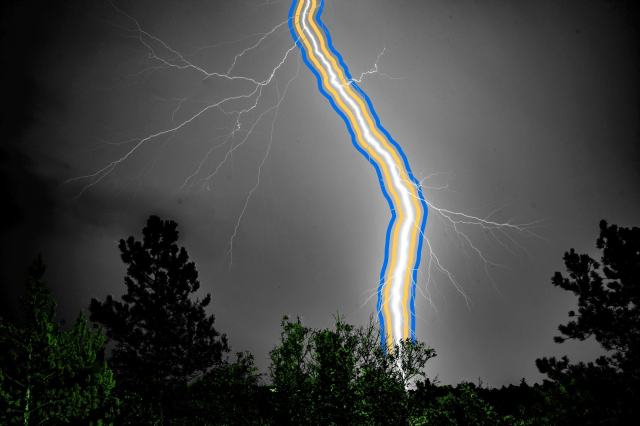
Depending on your perspective, Roy C. Sullivan was either one of the unluckiest people who ever lived or one of the luckiest — unlucky because the park ranger was struck by lightning a whopping seven times, yet lucky because he managed to survive every one of those encounters. He even holds the Guinness World Record for the most lightning strikes survived, a dubious honor if ever there were one.
The first lightning strike happened in 1942, when Sullivan was working at Shenandoah National Park in the Blue Ridge Mountains, and resulted in a lost big toenail. For the better part of three decades, nature saw fit to leave the “spark ranger” alone. Beginning in 1969, however, lightning seemed to have it out for him.
In 1969, he lost his eyebrows; in July 1970, his left shoulder was seared; in April 1972, his hair was set on fire; in August 1973, his hair caught fire again and his legs were seared; in June 1976, he injured his ankle; and in June of the following year, he sustained chest and stomach burns, all due to being struck by lightning.
Why he seemed to be the human equivalent of a lightning rod remains unknown. The National Weather Service puts the odds of being struck by lightning once in an 80-year lifetime at 1 in 15,300, making Sullivan a true statistical anomaly — especially considering the fact that his wife also survived a lightning strike. Sullivan passed away in 1983 at the age of 71, after having survived all seven strikes.
People used to believe ringing church bells repelled lightning.
Centuries after the superstition was debunked, some church bells still bear the inscription fulgura frango. Latin for “I break up lightning,” the phrase is evidence of a medieval-era belief that ringing church bells could prevent lightning strikes. The idea persisted until the late 18th century, but a number of bell-ringers getting struck by lightning over the centuries eventually helped people realize their faith was misplaced.
This is hardly the only way people have tried to avoid the elements, of course. Medieval-era Europeans used to plant Sempervivum tectorum, a plant also known as “houseleek,” “hens and chicks,” and “Jupiter’s beard” (Jupiter being the Roman god of thunder and the sky), on the roofs of houses and churches in the belief that it somehow prevented lightning and fire.

Michael Nordine is a writer and editor living in Denver. A native Angeleno, he has two cats and wishes he had more.


Comments
Post a Comment